A prediction game built on three layers of technology. Computer vision tracks ducks on live waterway feeds. Dolby Millicast streams the footage with sub-second delay. And every result gets written to a blockchain. All happening in 55-second rounds.
Most online games generate results with a random number generator. Duck River does something else entirely.
The system points a camera at a real river, canal or pond. An AI model trained on waterfowl recognition processes each video frame. When a duck enters a predefined detection zone, the model tags it, assigns it a tracking ID, and increments the count. That count is the result of the round.
What makes this technically difficult is not just the detection part. Ducks move unpredictably: they swim in circles, dive, reappear, overlap with each other. The model needs to handle occlusion (when one duck passes behind another), re-identification (when a duck leaves the frame and comes back), and motion blur from water reflections. 155.io trained their vision engine on thousands of hours of waterway footage across seasons and lighting conditions to handle these edge cases.
The detection grid is visible on the player's screen. Every duck inside the zone gets a bounding box in real time. You can count along with the AI. If a duck enters the zone at second 48 and leaves at second 53, you see it get tagged and added to the tally. There is no hidden logic.
So instead of a hash-based seed determining your outcome, actual animals on an actual body of water determine it. The AI is just the referee.
155.io published a technical whitepaper covering the model architecture: it runs a modified YOLO-based detector optimized for low-latency inference on edge hardware co-located near each camera site. Frame processing happens locally, not in a centralized cloud, which keeps the detection time under 40 milliseconds per frame.
Streaming a live camera feed is simple. Streaming it with under 500 milliseconds of delay is not.
Duck River uses Dolby Millicast (formerly Millicast, acquired by Dolby in 2021) for real-time video delivery. Standard live streaming platforms (Twitch, YouTube Live) operate with 3-10 seconds of latency. That gap is fine for entertainment but terrible for a game where the timer counts down from 55 and every second matters. Dolby Millicast uses WebRTC-based delivery, which pushes the video from the camera to your browser in under half a second.
Why does this matter for the player?
When you watch a duck enter the detection zone on your screen, that event happened less than 500 milliseconds ago on the actual waterway. The feed is as close to real-time as current streaming technology allows. Two players watching the same camera from different continents see the same duck enter the zone within milliseconds of each other. That simultaneity is what makes Duck River work as a multiplayer prediction game. Everyone watches the same reality at the same time.
Standard RTMP-based streaming would add a 4-8 second buffer. In that window, a camera could capture 3 or 4 additional ducks, which means the player's view would be out of sync with the actual count. Dolby Millicast eliminates that problem. The player sees what the AI sees, when the AI sees it.
| Streaming Protocol | WebRTC via Dolby Millicast |
|---|---|
| Typical Latency | 200-500ms (glass-to-glass) |
| Comparison: YouTube Live | 3-8 seconds |
| Comparison: Twitch | 2-5 seconds |
| Adaptive Bitrate | Yes, adjusts to network conditions |
| Minimum Connection | 4G or stable Wi-Fi |
The adaptive bitrate is worth mentioning. If your connection dips (moving between Wi-Fi and mobile data, for example), Millicast drops the video resolution before it drops frames. You might see a slightly grainier picture for a few seconds, but the feed never freezes and the latency stays consistent. That trade-off keeps the game playable even on inconsistent networks.
"Provably fair" gets thrown around a lot in online gambling. Most of the time, it means a game uses a hash-based seed system: the server generates a seed before the round, hashes it, and reveals the original seed after the round so players can verify. It works, but it still relies on the operator's server generating the seed honestly.
Duck River takes a different path. The result is not generated by a server at all. It comes from the real world (actual ducks counted by AI on a live feed). The blockchain layer sits on top of this as a record-keeping mechanism.
Here is how the verification chain works:
Players who want to verify a specific round can look up the transaction using the round ID provided in the game interface. The blockchain entry shows the final duck count, the exact timestamp, and the camera location.
The system does not use a custom chain. 155.io opted for an established public blockchain for transparency. Running verification on a private chain would defeat the purpose, because the operator could still theoretically control the chain itself.
One detail that often goes unnoticed: the snapshot hash. At the moment the round ends, the system captures a frame from the video feed and hashes it. That hash gets recorded alongside the count. If a dispute ever arises, the original frame can be compared against its hash to prove the AI's count matched what the camera actually showed at that instant.
Each bet type in Duck River carries a different probability curve, payout ratio, and expected return. Here is what the numbers actually look like.
Range asks whether the final duck count will land inside a bracket (for example, 3 to 7 ducks). The bracket width is calibrated by the system based on historical duck activity at the active camera location.
With roughly 40 wins per 100 rounds, Range is the most predictable bet type from a statistical standpoint. The variance is lower than the other three options. Your bankroll moves slowly in both directions, which means longer sessions before hitting either a significant profit or a significant drawdown.
The RTP at 93.5% is the highest available in Duck River. For every $100 wagered across enough rounds, the expected return is $93.50. The casino retains $6.50 on average.
Under predicts that the final count will stay below a specific threshold. The system sets this threshold based on average duck traffic for the active camera.
Winning 30 out of every 100 rounds at x3 gives you a theoretical return around 93%. The variance steps up compared to Range. You will experience longer dry streaks, but the wins compensate with a higher multiplier. This bet rewards patience and works well on quieter camera feeds (Kyoto overnight, Copenhagen in winter, Prague on early mornings).
Over is the reverse: the count must exceed the threshold. The lower win rate (roughly 1 in 4 rounds) is offset by the x3.6 payout. The RTP stays in the same 93% zone as Under.
Mathematically, Over carries more variance per session. You can go 8-10 rounds without a win and then recover it all in two. The Amsterdam and Bruges cameras tend to produce more duck activity during feeding hours (mid-morning in European time), which some players factor into their Over bets. Whether that pattern holds round to round is another question, but it gives you something to analyze beyond pure probability.
The Exact bet is the high-variance option. You predict the precise number of ducks that the AI will count during the 55-second window.
Five wins out of 100 rounds. Eighteen times your stake when you hit. The math checks out to an RTP of 91.5%, which means the house edge is higher at 8.5%. That cost is the price of the x18 multiplier.
The current record on an Exact bet is $363,971.16, won by streamer Xposed on April 12, 2026. He placed $20,000 on exactly 14 ducks during an Amsterdam feed and the AI counted exactly 14. At x18, that single round paid out over $360,000.
Exact bets are the part of Duck River that gets the most attention, but they are also the hardest to sustain over time. The 5% hit rate means you need 20 rounds on average to land one, and each losing round costs your full wager.
Duck River operates cameras across Europe, North America, Asia and Australia. The feeds rotate to maintain 24/7 coverage across time zones.
Each camera is paired with a local edge compute unit that runs the AI inference model. The detection parameters are tuned per site: the Amsterdam canal camera processes wider frames because ducks tend to spread out across the water, while the Kyoto stream camera uses a narrower detection zone since the waterway itself is smaller. Sydney's unit accounts for different waterfowl species (black swans appear occasionally, and the model correctly excludes them from the duck count).
The rotation schedule ensures that at least 2-3 cameras are active at any given hour. During European daytime (when Amsterdam, Paris, London, Bruges, Copenhagen and Prague are in good light), the system has the widest selection. Overnight in Europe, the feeds shift to Sydney, Vancouver and New York.
RTP stands for Return to Player. It is the percentage of total wagers that a game returns to players over a large number of rounds. The key phrase is "large number." Over 50 rounds, your actual return can be anywhere from 0% to 300%. Over 50,000 rounds, it converges toward the published RTP.
Duck River has four RTPs because it has four bet types:
| Bet Type | RTP |
|---|---|
| Range (x2.25) | 93.5% |
| Under (x3) | ~93% |
| Over (x3.6) | ~93% |
| Exact (x18) | 91.5% |
The house edge is the inverse of RTP. On Range bets, the casino keeps 6.5 cents per dollar wagered on average. On Exact bets, it keeps 8.5 cents. The difference reflects the risk profile: Exact bets require a larger margin because the x18 multiplier concentrates payout variance.
How does this compare to other formats? Crash games like Aviator or Spaceman run at 96-97% RTP. Blackjack with correct strategy sits above 99%. Standard video slots hover between 93% and 96%. Duck River's range of 91.5-93.5% falls slightly below software-based crash games.
That gap has a technical explanation. Running 10 live cameras around the world with sub-second streaming, processing video through AI models at each site, and recording every result to a blockchain is more expensive than generating a random number from a server seed. The infrastructure cost gets built into the house edge.
For the player, the trade-off is concrete: you accept a slightly higher house edge in exchange for results that come from the physical world rather than from software. Whether that trade-off is worth it depends on how much you value transparency and provability over raw RTP percentage.
One thing to keep in mind: the RTP is identical across all casinos that carry Duck River. 155.io sets the parameters at the game level. Stake, Shuffle, Roobet (and others via Hub88) all run the same backend, so the odds do not change depending on where you play.
155.io is a Swedish studio that started in 2024 with a simple question: what if game results came from the real world instead of software?
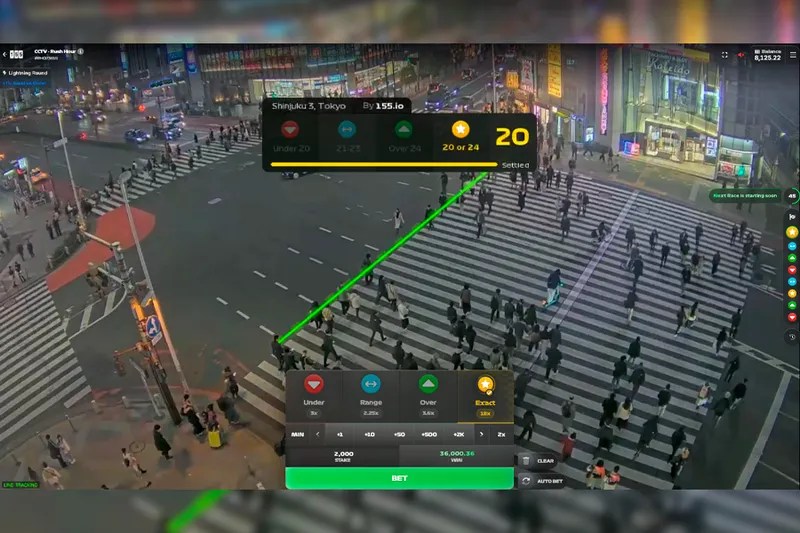
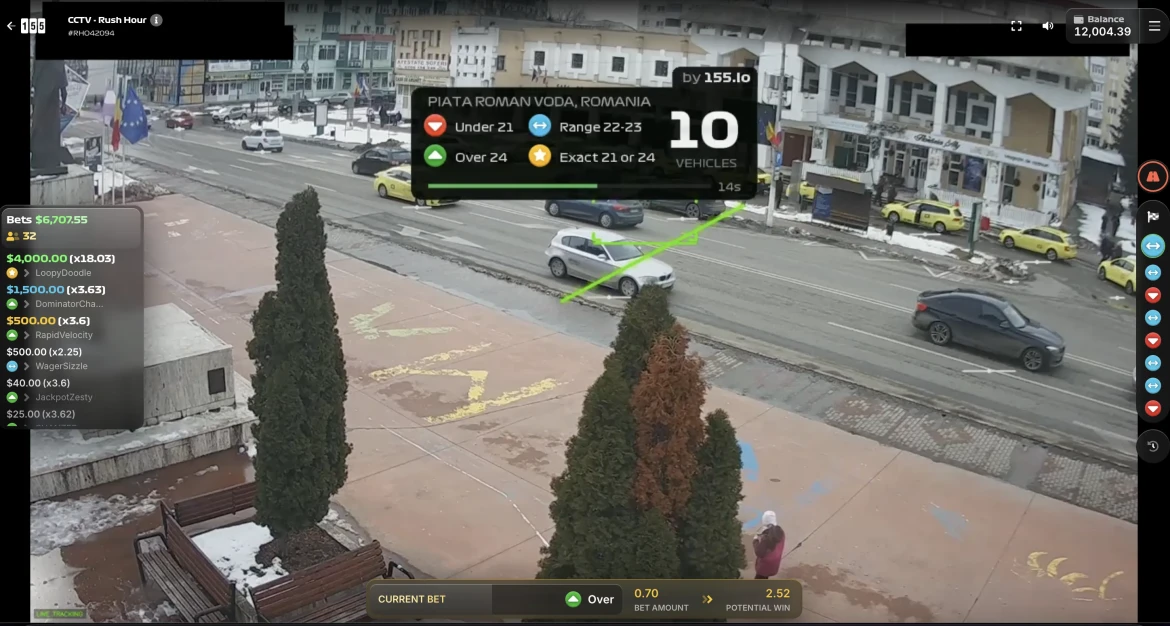
Their first release was CCTV Rush Hour, a game that used live traffic cameras to generate betting outcomes based on vehicle counts. The concept proved that real-time computer vision could replace traditional RNG in a production gambling environment. It also surfaced the hard engineering problems: latency synchronization, edge AI inference, camera reliability during weather events, and on-chain verification at scale.
Duck River is their second title. Same core architecture, applied to waterways and waterfowl instead of roads and cars. The AI model is different (trained specifically on duck morphology and movement patterns), but the streaming pipeline and blockchain layer carry over from CCTV Rush Hour.
The studio runs a lean team. Most of their engineering investment goes into three areas:
Distribution goes through Hub88, which connects 155.io's games to licensed casino platforms globally. The casinos handle the player accounts, payments and compliance. 155.io handles the game engine, the cameras and the AI.
Upcoming titles include Ducks.io (plastic duck racing on real water channels), Marbles and Stairpong. All follow the same principle: physical events, filmed live, verified on-chain. No RNG anywhere in the pipeline.
Duck River launched on March 24, 2026. It went live simultaneously on Stake, Shuffle and Roobet. It is also available on 1win and PIN-UP.
Early reactions from players with a tech background
« I work in ML engineering, so the first thing I did was watch the detection model work for about 30 rounds without placing a bet. The bounding boxes track cleanly even when two ducks overlap. I saw one edge case where a reflection on the water got briefly tagged and then de-tagged within a second. After that I was convinced the model is solid. The blockchain verification sealed it for me - I checked three round hashes on-chain and they all matched. Now I play Range bets during lunch breaks. »
« The Dolby Millicast integration is genuinely impressive. I tested latency by opening the same camera on two devices side by side. The difference was maybe 100-150ms between my laptop on Wi-Fi and my phone on 5G. For a live game, that is very tight. My only complaint is the house edge - 6.5% on Range is fine, but 8.5% on Exact feels steep even considering the infrastructure costs. Still, I would rather lose 8.5% to a game I can verify than 3% to a black-box RNG I just have to trust. »
« I got into Duck River because of the provably fair angle. Most "provably fair" games use hash-based seeds, and while those work, you are still trusting the server to generate seeds honestly. Here, the result comes from actual ducks. The server does not decide anything. I ran 200 rounds of demo to build a statistical baseline, then started with Under bets on the quieter cameras. Up about 12% over my first real-money weekend. Solid experience. »
The computer vision model is trained specifically on duck morphology. It recognizes body shape, size, swimming pattern and movement speed. Other waterfowl (swans, geese, herons) are classified separately and excluded from the count. The model updates its parameters periodically to account for seasonal changes in duck appearance (molting, juveniles vs. adults).
If a camera feed drops during an active round, the round is voided and all bets are returned. The system detects feed interruptions within 2 seconds. If the drop is brief (under 3 seconds) and the AI maintained tracking continuity, the round continues. Prolonged drops trigger automatic voiding. Bets placed on voided rounds get refunded in full.
Yes. Each round produces a transaction ID visible in the game interface. That ID links to a public blockchain record containing the final duck count, camera ID, timestamp and snapshot hash. Anyone can look it up using a standard block explorer. No account or special access required.
Dolby Millicast delivers the feed via WebRTC, which provides sub-second latency globally. In practice, most players experience 200-500ms of delay depending on their network. The variation between players is small (typically under 200ms difference), and since bets close before the round starts, latency does not affect the outcome or fairness.
Yes. Ducks are most active during dawn and dusk feeding periods. Mid-day activity varies by location and weather. Night cameras switch to infrared mode, and duck traffic tends to be minimal. The game's thresholds for Over/Under bets adjust dynamically based on recent activity at the active camera, so the odds stay balanced regardless of the time.
Duck River launched on Stake, Shuffle and Roobet on March 24, 2026 through the Hub88 distribution network. It is also available on 1win and PIN-UP. The game backend is identical across all platforms, so the RTP and bet types are the same everywhere.
Yes. Duck River has a free demo mode on partner platforms. No registration, no deposit. The demo runs the same live camera feeds, same AI detection, same interface. The only difference is that credits are virtual. It is a good way to study the system and test your read on different cameras before committing real funds.
Streamer Xposed hit $363,971.16 on April 12, 2026. He placed a $20,000 Exact bet predicting 14 ducks on an Amsterdam canal feed. The AI counted exactly 14 when the timer hit zero. At x18, the payout came out to $360,000 plus his original stake. The round is verifiable on-chain.
Duck River runs over 60 rounds per hour. Each round is 55 seconds. The pace creates a rhythm that can make it easy to lose track of time and spending. The technology behind the game is interesting, but it does not change the fact that the house holds a 6.5-8.5% edge on every bet.
That edge is a mathematical constant. No amount of camera watching, pattern analysis or feed timing eliminates it. Over enough rounds, the casino retains its percentage. Short-term variance creates wins and losses, but the long-term trend favors the house. Understanding this is part of engaging with the game responsibly.
All licensed partner casinos provide deposit limits, loss limits, session timers and self-exclusion options. Use them.
Need support?
GambleAware - www.BeGambleAware.org
GamCare - 0808 802 0133
GamStop - www.gamstop.co.uk
Duck River by 155.io is a prediction game where every result comes from the physical world. Computer vision counts, Dolby Millicast streams, and the blockchain records. The tech stack is open for inspection, and the demo is free.
Launched March 24, 2026. Available on Stake, Shuffle, Roobet, 1win and PIN-UP. Four bet types, 10 camera locations, 55-second rounds.